

Welcome To The Bessent Put
Suspicious Timing
Moar Cowbell?
Liquidity Problems Will Demand Much More Liquidity
Swapping Cheap Debt For Expensive Debt
A Nicotine Patch For Lung Cancer
Welcome To The Bessent Put
I did a live premarket rant Wednesday on Treasury’s expanded long-end buyback program that immediately triggered dollar down, yen up; yields lower, gold & equities higher - just as key support was threatened.
Suspicious Timing
Yup, Bessent intervened!
The U.S. Treasury is doubling long-end bond buybacks as it moves to shore up liquidity in one of the most pressured parts of the market.
Starting Sept. 9 buybacks for 10–20Y and 20–30Y Treasuries will rise from $2B to at least $4B per operation.
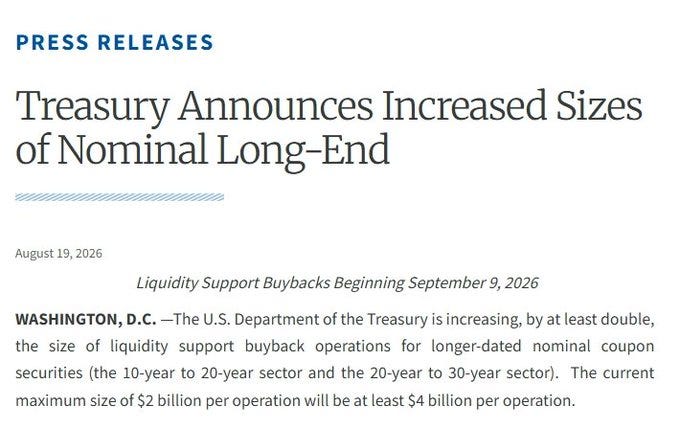
Curious the timing given just two weeks ago, the Treasury had just announced its buyback operation calendar for the next three months and no mention of buybacks.
Clearly, the bond sell-off of late pushing the 30-year yield to hit a 19-year high at 5.33% forced the Treasury’s hand - conveniently on the SAME day as an upcoming 20Y Treasury auction that came in weak.
Oh the timing!
The auction did in fact tail by 0.5 bps with the bid-to-cover ratio falling below both the prior auction and six-auction average.
Oh the timing!
Trump Summit: President Donald Trump met with major crypto executives at the White House, renewing political pressure on Congress to pass the stalled Clarity Act market structure bill.
SEC Policy Shift: The SEC announced a surprise proposed framework offering registration exemptions and disclosure rules tailored for crypto assets, creating a cleaner pathway for compliant network operations.
Bitcoin surged past $71,000 yesterday, breaking out of a six-week stagnant range as a massive short squeeze liquidated roughly $2.7 billion to $3 billion in bearish bets.
Oh the timing!
Conveniently, the duration of Treasury buybacks lasts “through November 4, 2026” - one day AFTER the midterm elections.
Moar Cowbell?
Let’s zoom out first:
The total outstanding U.S. Treasury market stands at approximately $31.5 trillion.
But long-term U.S. government AND corporate bond sectors represent $50.5 trillion.
The total U.S. bond market is approximately $58 trillion (comprising Treasuries, corporates, municipals, and mortgage-backed securities).
Here’s the Bessent Put in perspective.
These announced Treasury buybacks represent a rounding error:
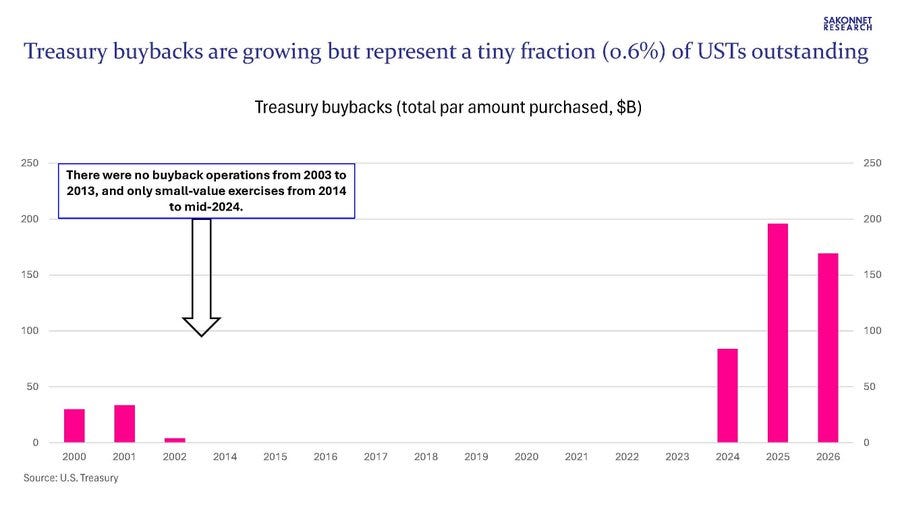
Chart h/t @Adam__Josephson
“Buybacks represent a tiny fraction of the Treasury market even after being temporarily upsized, and need to be funded with yet more short-term debt.”
But oh boy, that is not how market bulls interpret.
Here is Raoul Pal of Real Vision:
“The extra dollars are small. The signal is enormous.
For the first time, the fiscal authority, not the Fed, stepped in to defend the long end within 24 hours of the highs. There is now a put under the long bond, and the market has just been told the top of the range...
Lower long-end volatility raises the collateral value of every Treasury in the repo system, which is itself a liquidity easing. And the QRA language quietly changed two weeks ago to allow exactly this.
With a long end now potentially anchored, the steepening of the curve should come from Warsh, who will probably deliver his part of the grand bargain between the Fed and the Treasury.
All of this is to fund the hyperscaler capex along with government debt. For the first time since the GFC both public and private debt as a % of GDP are growing and both are vital.
This is the everything code fully at play and brings together many threads I've been talking about for the last two years. The debt must be serviced and liquidity, by whichever mechanism they can route it, is the method.Financial conditions started easing through both legs at once today, and financial conditions are the first domino in the sequence we have been mapping all year.
To be warned this is not an instant liquidity flood happening right now. This is the entire scaffolding being set up for the much larger game. The Great Game is the funding of the aging population along with the funding of the new demographic of AI and robots. Both games are too big and too important to stop. The funding of the the intelligence build out is the most important game of all time. It is too big to fail.
Emphasis mine.
Liquidity Problems Will Demand Much More Liquidity
Diane Swonk, Chief Economist of KPMG_US, details a bunch of the reasons why Bessent intervened:
The market has liquidity problems, which the Treasury can help with on the long end. However, the fundamental problems that we face have not changed:
1) Federal debt issuance held by the public eclipsed WWII levels earlier this year. Deficits and debt continue to rise.2) Inflation is still a worry and the conflict is still with us. Diesel prices get into just about everything. That is a problem.
3) AI-related debt is competing with Treasury debt.
4) If we issue shorter term debt to lower long term yields, it will need to be financed sooner, and likely at higher rates.
5) Sovereign debt issuance has soared, which is already exceeding demand a jet rise in rates needed to get investors to lend.
6) Gulf states with large wealth funds need to turn even more inward due to Middle East conflict. That means less demand for debt and more defense outlays, another issue global in scope and inflationary. Dovetails with the AI boom.
Bottom Line: we get some relief in long duration rates, including mortgages but the trend is still in the wrong direction on rates. Even with interventions, rates still above the level prior to rate cuts by the Fed. Rate hikes are going to make the short end duration rise, which is even more interest expense. Bond vigilantes getting restless in this debt environment.
Again, emphasis mine.
On this I agree with Diane:
“Bottom Line: we get some relief in long duration rates, including mortgages but the trend is still in the wrong direction on rates.”
As I said live in my trading room Wednesday, I don’t think this Treasury buyback intervention will stick any more than I thought his yen intervention on July 30th would stick.
My bet: bonds & yen move violently sideways into end of year - then let’s talk Q1 2027 (earliest).
But if $WTIC pierces > $120 🥺😩
Or UE rate hits 4.6%? ☄️⚠️
We can talk sooner 🙃
Wolf Richter reminds and this bears watching…
There are 7 buyback auctions in the 10-year to 20-year sector and in the 20-year to 30-year sector scheduled during that buyback period from September 9 through November 4:
Sep 10: 10-year to 20-year
Sep 24: 20-year to 30-year
Oct 01: 10-year to 20-year
Oct 08: 20-year to 30-year
Oct 15: 10-year to 20-year
Oct 27: 20-year to 30-year
Nov 04: 10-year to 20-year
“that would increase from $2 billion face value each to $4 billion face value each, so that total buybacks would increase from $14 billion face value to $28 billion face value
It’s minuscule because there are $4.4 trillion of 10-year notes outstanding, and $5.5 trillion of 20-year and 30-year bonds outstanding, combined nearly $10 trillion with a T.
So the $14 billion with a B in additional buybacks in that period would amount to a little over one-thousands (0.14%) of those securities already outstanding. And that $14 billion would be obtained by increased issuance of other securities, such as T-bills, at higher interest rates.”
Swapping Cheap Debt For Expensive Debt
This day is not synonymous with the ‘Powell Pivot’ or my often-cited “Powell Pause & Yellen Yahtzee” of November 1st, 2023 - when Powell announced rate hikes would be paused and Yellen announced that Treasury would finance government deficits with liquidity-providing shorter-duration bills over liquidity-sucking notes and bonds. The market moved strongly higher and November 16th, 2023 I said this would be “1995-ish bullish”. This is the “Bessent Put” that really isn’t.
Oh the irony how Bessent bashed Yellen for funding on the short-end as political!
“Secretary Yellen is financing at the front end of the curve…we’ve got to do something, because at a point there will be a problem (link).”
What has he done since taking over the job? Bessent has held coupon (meaning longer-term debt) issuance constant against the advice of the Treasury Borrowing Advisory Committee (TBAC) (link)! And he encouraged Japan to use the Federal Reserve’s (Fed) FIMA Repo Facility in lieu of selling its Treasury holdings to support the yen! And as we head into the volatile two-months ahead of midterms, Bessent even pulled a Draghi this month and said, “whatever it takes”.
Is this all cover for Japanese Insurers under pressure or an orchestrated Crypto squeeze or simply the bailing out of Warsh ahead of Jackson Hole next Friday?
Seems Bessent would rather manipulate USD lower - as rest of world chases the US AI trade in USD - versus pressure Private Credit with rising yields. And curious how the yen intervention and this Treasury buyback announcements this month manipulate the dollar lower as Japan is swapping out its UST from longer-to-shorter duration.

Peter Boockvar, Chief Investment Officer of One Point BFG Wealth Partners, highlights the unsustainability of this move as well:
Bessent is buying long term Treasuries well below par, likely those with coupons with a one handle or less that are trading at $.50 on the dollar and issued when short rates were at zero. But, by replacing that with T-bills currently yielding around 3.75%, US interest expense will go higher. Also, in response, the US dollar is trading at 3 month low today and if sustained, that imports inflation and could facilitate foreign selling of Treasuries for those not FX hedged.
And you know how I feel about Warsh hiking any time soon. It’s HOGWARSH given the interest expense on rolling $10 trillion in short-duration T-bills that get rolled into year-end.
Hiking short-term rates would only inflate US debts and deficits resulting in higher long-term rates. And that’s before any new oil or supply-shock inflation scare.
I also agree with @wolfofwolfst:
It’s a hocus-pocus show because the Treasury cannot print money, but has to issue debt to buy back debt, and because the amounts are too small to matter. Its sole purpose is to verbally manipulate the bond market to push up bond prices and push down long-term yields, and the bond market loves to be manipulated to where prices rise because existing bondholders, especially leveraged funds, can make a lot of money, and they just need a buy signal, and Bessent just gave them another buy signal. But it only works briefly.
Kinda like moving debt from one credit card to another with a longer grace period - except in this case, the interest expense is higher. The treasury buyback causes the debt to come down a little due to the roll, but the interest expense in dollar terms goes up, causing the deficit to increase.
JP Morgan is in MarketWatch this morning warning of the same thing.
without “real fiscal consolidation” markets could “view this action as lacking credibility.” That could drive term premium and yields higher over time if the Treasury breaks with a stance it set up decades ago to issue bonds on a “regular and predictable” basis
JPM warns, as Geoffrey has, that only the action to reduce the debt will have lasting effect. More likely, Treasury could now try to reduce long-end auction sizes.
Bessent intonated the same on CNBC this morning,
“we believe that the yields don’t reflect the underlying fundamentals…”
A Nicotine Patch For Lung Cancer
Swapping cheap debt for expensive debt is a wealth-degrading trap for US. The major reason Bessent would intervene is because of actual or threatened buyers strike on longer-duration bonds.
As discussed, there are multiple reasons for this:
1. Corporate IG issuance at higher yields attracting fixed income away from UST auctions.
2. Inflation risks on falling dollar, war, fiscal dominance, etc
3. Bond raiders & Yen shorts re-engaging until Japan decouples from US & is more energy-independent.
But the biggest reason is Japan:
Japanese yields should continue rising as inflation, energy costs and BOJ policy push the domestic rate structure higher. That gives Japanese banks, insurers and pensions less reason to continually send capital abroad. Japan does not need to dump Treasuries for this to matter. Simply buying fewer U.S. bonds or allowing more capital to return home removes an important marginal buyer from the long end. That puts additional pressure on Treasury yields precisely when U.S. issuance remains enormous and could transmit volatility across global sovereign markets.
So eyes on oil and Japan.
As I have warned, Crude moving firmly above $120 becomes increasingly difficult for Bessent to suppress yields. This oil-driven inflation shock would directly feed into corporate margins and household budgets.
Fed is trapped.
An energy shock makes inflation worse as Fed cuts into a weakening economy. Weaker spending triggers layoffs and credit stress. The cure for higher prices are higher prices as they say, resulting in demand destruction which gives way to deflation impulse resulting in recession. We aren’t there, but it bears reminding to keep wath on oil rising, which pulls yields higher with it, and Japan (selling dollars and going home).
US 10Y 4.8% is the maginot line.
I am not surprised Bessent has intervened twice this month as the 10Y US pushed into 4.75% last month. I have long stated that once we get & stay above 4.8%, the rate of change can start to be felt into 5% (the Nov 1st, 2023 “Powell Pause & Yellen Yahtzee” high).
Long-end is policy battleground.
Make no mistake, yield curve control & duration management are financial repression tools to protect future auctions and prevent rising term premium. Bessent has employed these tools (like Yellen before him) against a backdrop of fiscal dominance & political expediency.
That doesn’t mean the long-end rising on war, inflation & supply issuance concerns is fixed!
And that doesn’t mean a Protracted/Escalating regional Middle East War risk is falling!
But it is curious that Bessent chose THIS day to intervene as the selling under the surface kicked in Monday & bullish AI news couldn’t bolster buying & the 10Y2Y bear steepener picked up speed (as warned). He stepped in so that an ordinary bond selloff didn’t turn into a Treasury market liquidity event.
And given the size of the refunding announcement, Bessent is gonna need a bigger boat. “Liquidity support” in the form of buyback operations in the long-end is not nearly enough to satisfy growing issuance of $16 trillion alone this year.
But... it **could** affect a big, important signalling reaction:
A flattening of the yield curve can drive real rates lower which is stimulative - along with lower USD - if it sticks.
Add to that, **IF** inflation expectations FALL with mortgage spreads, then a normative Fed rate CUT could be back on the table.
But I still think this will be super hard to do given lack of consensus on FOMC board unless labor cracks hard. Also, as the future inflation from falling dollar will add to the difficulty.
But a Fed rate cut, in addition to these backstops by Bessent, does put my SPX $8200 2026 (MarketWatch call Dec 30th 2025) in full view again on falling dollar. So we’ve got that going for us.
As for this Bessent intervention, Geoffrey sums up succinctly:
Bessent’s “move is a nicotine patch for lung cancer.”