
Revisiting 'Trend Portfolio Construction' In An Era Of AI & Passive Investing

How To Create Alpha Outside Tech
I have a very boring but very profitable Trend-Long Only Portfolio for LaDucTrading CLUB/EDGE clients. It tends to have very little in the way of tech exposure. Most tech-bro groupies will stop reading right here, but I would like to remind that many investors are already PASSIVELY/heavily invested in tech markets just through association in owning SPX & NDX. Specifically, the concentration risk of Megacap Tech in these indices brings sufficient exposure for that portion of a portfolio return. My goal was to focus elsewhere and it has worked exceedingly well.
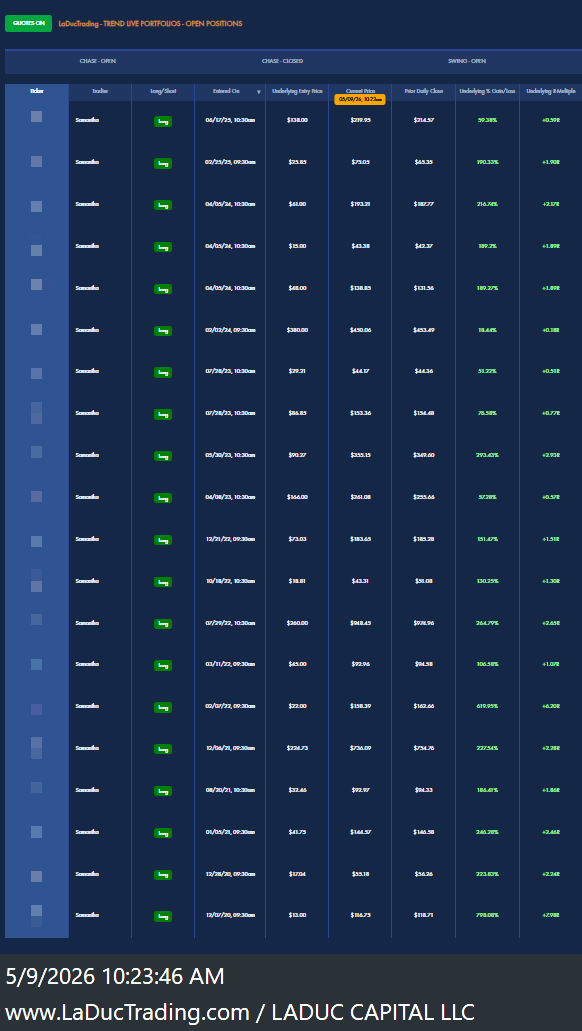
This was my thinking, anyway, when I first started accumulating positions for clients in 2020 in my mostly value-vs-growth names for multi-month/multi-year trends.
Now fast forward six years, and some might see this value-focused, trend-long-only portfolio construction as ‘missing out’ on the AI wave, but that only assumes no exposure to passive investing in NDX & SPX which is not the case. This portfolio was always intended to augment not replace the benchmark.
Most investors have some portion of their long-term wealth on default: passive investing. This portfolio management theme has only grown over the years, and with it the concentration risk in markets (more on that below). Then there is AI, and all that has done for the market’s advance (more on that below).
My research will show that any passive investing vehicle already provides all the AI-focused returns a long-term investor needs given the exponential rise in stocks within the AI ecosystem over the past three+ years since ChatGPT was introduced that are capital-weighted in the indices.
And despite all of the hindsight rewards of an AI-focused portfolio, I decided I will continue to focus my Trend-Long-Only Portfolio construction on names remaining outside the high concentration risk arena - given Growth/Tech/AI investments are already inherently built into SPX & NDX, and since most have a piece of this in their investment portfolios already.
As such, given my focus on separating out CHASE, SWING & TREND timeframes, I will continue to have an AI-Tech-Stack focus for clients in our active Chase & Swing Portfolios - which are geared toward holding periods of weeks to a few months - and let the tech-heavy NDX & SPX concentration risk drive the rewards in our passive positioning.
Focus on Value for Diversification & AI for Deliberate Concentration
I tend to focus on more value and macro plays as a means of diversification - with a more fundamental stock picking approach that meets technical analysis criteria based on my years of market timing calls on market direction, sector rotation and stock selection.
In short, an index position by design is a mechanical investment and does the stock picking for you - while also lumping the winners & losers together. Passive investment as a structural investment strategy does not/cannot hold a view.
But we do as humans. And it’s more fun to express that view in the form of a self-directed portfolio where the goal is focused diversification that is actively-managed. My discretionary portfolio comprises how I express a view on my highest conviction plays while also working to outperform passive investment benchmarks. My mantra: Long & Strong vs. Wrong & Gone. Translation: I create more alpha by only holding winners.
If my stock pick breaks either the thesis for adding them - fundamentally or technically - I let them go and allocate that money into a more productive pick.
And then let compounding do the rest of the work. I call it my “Boring But Profitable” approach to investing. Quality over Quantity; Value over Growth.
The goal is to hold both active & passive investments in partnership - both risk-managed - but on an investment timeframe of many months-to-years.
Example of a well-placed stock pick in ASTS:
Sock-Drawer Trade Up 7200% Since February
Samantha LaDuc June 9, 2025

ASTS as a “New Trend Long”
And my recommended trend long in URANIUM:

Revisiting ‘Trend Portfolio Construction’ In An Era Of AI & Passive Investing
The rest of this article focuses on a summary of key concepts around active portfolio management - taken from a compilation of sources that pre-date the recent earnings season (and increased Capex spending by MAG4 hyperscalers). Here’s the data and the risk/rewards I see…
The Concentration Risk in US Equity Markets
Impact of AI on Market Structure and Performance
AI Capex Cycle Risks and Market Impacts
Risks & Opportunities in Market Concentration & Active Fund Management
Passive Flows and Market Mechanics In Sell-offs
Building an AI-Era Equity Portfolio
Augmenting Mechanical to Conviction Portfolio Management
The Concentration Risk in US Equity Markets
The US equity market is increasingly dominated by index funds and a small group of mega-cap stocks, creating potential structural risks from concentration risk:
Index funds held 52% of long-term US fund assets by end of 2025, up from 19% in 2010 and 3% in 1995.
Passive assets crossed 55% of US retail mutual fund and ETF assets in 2025.
79% of large-cap active funds underperformed the S&P 500 in 2025, marking the fourth narrowest year since 1995.
Market capitalization weighting causes larger companies to grow bigger, disconnecting prices from fundamentals.
Academic research shows every $1 invested in US equities raises market value by roughly $5, indicating inelastic demand.
Index inclusion boosts stock prices by about 2.79%, and ETF ownership increases daily volatility by approximately 16%.
The five largest US fund complexes own over half of all US fund assets.
Major fund complexes (BlackRock, Vanguard, State Street) control 88% of S&P 500 companies, reflecting even greater market concentration.
The top 10 stocks now account for approximately 40% of the S&P 500, with the Magnificent 7 making up 33.7%. It is expected to grow to 50% once SpaceX, OpenAI and Anthropic launch their IPOs.
The top companies generate 70% of the index’s economic profit, but 30% of the index’s weight is supported by mechanical buying, not fundamentals.
Impact of AI on Market Structure and Performance
AI is creating a K-shaped effect, benefiting a small group of hyperscalers and AI winners while compressing margins and threatening traditional businesses.
Currently, the index is a concentrated bet, with 40 cents of every dollar in ten companies, mostly tied to AI growth.
Capital expenditure by Amazon, Microsoft, Alphabet, Meta, and Oracle is forecasted at $602 billion in 2026, with 75% ($450 billion) dedicated to AI infrastructure.
Hyperscalers are raising $108 billion in debt in 2025, with projections of $1.5 trillion over the coming years.
Nvidia contributed roughly 20% of the S&P 500’s 2025 return; the Magnificent 7 accounted for about 42%.
AI infrastructure spending is more than doubling from 2022-2024, with Goldman Sachs projecting $1.15 trillion across 2025-2027.
Companies benefiting from AI are experiencing concentrated revenue gains, while many others face margin compression.
AI-driven margin compression and substitution threaten niche/specialized (long-tail) legacy companies.
Sectors most exposed to AI disruption include commoditized software, professional services, content/media, legacy financial services, and white-collar labor-dependent industries.
AI Capex Cycle Risks and Market Impact
The AI infrastructure buildout faces potential setbacks due to unprecedented capital intensity, which could lead to a correction in AI-related asset prices, but this would not reverse the structural growth of AI-driven businesses or their disruption of traditional sectors.
Hyperscaler capital expenditure (capex) at 45% to 57% of revenue is unprecedented for software firms.
Bank of America estimates hyperscaler capex now accounts for 94% of operating cash flows after dividends and buybacks.
Depreciation for $2 trillion in AI assets implies over $400 billion annually by 2030, surpassing the 2025 profits of all five hyperscalers.
Goldman Sachs notes stocks diverge based on whether capex is debt-funded.
A capex correction could reprice Nvidia, chip ecosystem, data centers, and power providers.
Such a correction would impact the infrastructure layer but not reverse AI’s substitution for white-collar labor or automation benefits.
The bottom of the “K” (disruption) is structural; a capex slowdown would mainly correct the top, leaving the index in a middle position owning both winners and disrupted businesses.
Risks & Opportunities in Market Concentration & Active Fund Management
Market concentration and mechanical buying creates capital-weighted index outperformance but also masks underlying volatility risks from abrupt moves in individual stocks.
2025 saw only 30.5% of S&P 500 stocks beat the index, the fourth narrowest year since 1995.
The implied dispersion index (DSPX) was well above its long-term average, indicating high potential for active management. High dispersion regimes create more room for stock pickers to generate excess returns.
Active managers underperformed because they are often underweight mega-caps due to risk rules and diversification mandates.
The same concentration that boosts index returns also makes it dangerous; active managers who deviate from the benchmark are penalized.
Mechanical (quant and vol fund) buying amplifies both upward squeezes and downward dislocations, especially during earnings or guidance surprises.
The index’s structure leads to a false sense of calm on the surface, hiding underlying volatility and breadth weakness.
Rebalancing effects and ETF ownership increase stock volatility and spreads, which reverse sharply during sell-offs.
The index owns both winners and losers, which can mask the true divergence in company fundamentals as capital-weighted stocks outperform.
The next decade is likely to favor concentrated, deliberate portfolios that differentiate winners from losers - and AI-disruption-resistant companies, rather than broad market exposure.
Passive Flows Meet Price-Insensitive Mechanical Buyers & Sellers
Passive investment flows remain strong, but their composition misaligns with future economic realities, risking a divergence between index returns and active management.
Passive assets are at an all-time high, with flows favoring passive 3:1 over active.
Passive equity ETFs led in 2025, while active equity funds faced their 11th year of outflows.
In 2025, the market experienced a massive shift toward passive investing, with passive funds (ETFs and mutual funds) drawing approximately $903 billion to $918 billion in net inflows, while active funds suffered significant outflows estimated between $189 billion and $640 billion.
The mechanical bid from passive flows continues, but it increasingly buys a basket misaligned with forward economics.
Divergence between index performance and active strategies will likely widen as the “K” deepens.
Passive flows do not provide protection; they can amplify risks during market downturns.
When passive owners hold large market shares, marginal sellers and price-insentive quants sell mechanically during downturns, increasing volatility.
Building an AI-Era Equity Portfolio
A disciplined portfolio in the AI era should focus on four pillars, each based on durable, structural winners, and avoid the index’s long-tail of losers.
Pillars include AI infrastructure, AI-native software, disruption-resistant compounders, and adjacent winners.
AI infrastructure covers semiconductors, hyperscalers, data centers, networking, memory, power, and cooling.
AI-native software includes foundation models, AI applications, enterprise platforms, and proprietary data moats.
Disruption-resistant compounders are regulated infrastructure, real assets, market plumbing, brands with pricing power, and AI-immune sectors.
Adjacent winners involve potential stablecoins, digital payments, cybersecurity, fintech, and digital asset infrastructure.
The index owns many names proportionally, but active managers should selectively own winners and avoid commoditized or disrupted sectors.
The approach emphasizes identifying, sizing, and holding high-conviction AI winners through volatility.
Augmenting Mechanical to Conviction Portfolio Management
Market inelasticity and concentration risk are increasing due to passive flows and large ownership by major fund complexes. The concentration of economic value and market dominance by few names increases systemic risk.
Active, high-conviction strategies will generate alpha by owning structural winners and avoiding losers.
Index investing is a mechanical bet on past weights, unlikely to succeed in the new regime.
Building a deliberate basket of winners and disruption-resistant businesses is crucial.
The market will experience rapid moves, requiring pre-emptive work and high conviction to navigate volatility.
The key distinction is between conviction-based investing and mechanical indexing; the latter cannot adapt as well to the AI-driven regime.
Disciplined, high-conviction active investing with passive components, as markets become more concentrated, will continue to reward the active portfolio manager, and those who manage their own.